|
|
|
|
||
|
|
||
|
||
|
|
|

Content of this page:
Another way to define a KYTRON would be as a small electro-mechanical device mimicking some aspects of natural life.
Finally a KYTRON could be described as a small mobile robot doing nothing meaningful except keeping itself happy...
In fact, KYTRONs have nothing to do with military equipment at all, and are definitively not armed.
All five KYTRONs built so far feature
tracks, but there is no reason that this will not change. I always had
the plan to make one with (six) legs, like an insect. I am not much interested
in designs with wheels, but then, this may change when I will see pictures
of the new Mars rover. I also have to admit that the Lunachod moon vehicle
(8 wheels) of the Russians was a great design.
And yes, I had that soft-lined "translucent
design" since 1975 (!!!)... see my images of KYTRON 2 and
m-KYTRON 3 below. (Obviously these new images were taken in
1999.)
Return to top
of page...

The first KYTRON was done in 1974. The mechanical parts were taken from a toy. The wheels and crawler tracks were plastic parts. The housing was made from foam plastic.
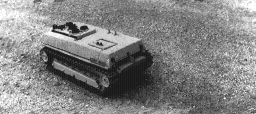
This KYTRON searched for light with three alternative optical sensor devices. The most advanced was a rotating sensor arrangement, using two light sensors looking forward, with an optical shield between them. When either sensor saw light, the motors were started so that the KYTRON would approach the light source.
If no light was seen, every 5 minutes the rotor was activated in order to find light in other directions. When such light, f.i. from behind, was detected, the KYTRON would turn the sensor device back to home position and simultaneously would turn itself to face this light source. Then it would approach it as above.
The obstacle avoidance capability of
KYTRON 1 was very limited. It had a mechanical touch sensor on front. When
detecting an obstacle, it would stop immediately and drive back a curve
to the right. When trying to approach the light again, it would probably
touch the obstacle again, but thanks to mechanical fuzziness it would (hopefully)
finally manage to get by. KYTRON 1 was 30 cm long, 15 cm wide, and 12 cm
tall. It was destructed in 1977 (see KYTRON 4). Its weight was 1.5 kg and
its speed was 24 cm/s. It could operate 30-60 minutes from its Pb-gel batteries.
The electronics consisted of about 100 parts, including 1 IC.
Return to top of page...

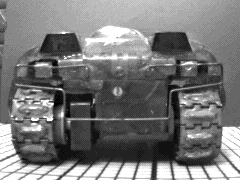
In 1975 KYTRON 2 was constructed. All the mechanics are custom fiberglass parts. Only the tracks were built from small brass hinges, which were soldered together. For interaction with the driving wheel, two notches were added on the inside of each chain link. (This MPG movie clip shows these tracks in detail, 527 K).
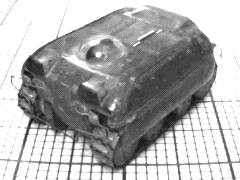
KYTRON 2 is smaller and uses much
less power than KYTRON 1. All logic circuits are realized in the then-new
CMOS SSI devices. (The CMOS chips were not only new, but rather expensive
too. A simple CD4011 containing 4 NAND gates was 5 DM then.) When stopped,
power consumption is less than 10 uA (micro Ampere) at 4.8 V. The mechanical
data are: length 19 cm, width 14 cm, and height 9.5 cm, and its weight
is 1.2 kg. Its speed is 9 cm/s. The electronics consist of about 220 electronic
components, including 19 ICs.
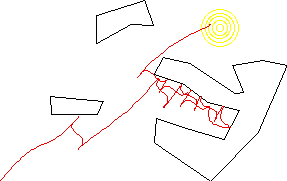
This KYTRON has some intelligence when circumventing obstacles on its way to light. It takes the location of an obstacle into account, and remembers its directions in order to master dead ends in a more complex situation (call it "maze" if you like). Real mazes are not handled by this KYTRON, though. An example trace is the following sketch: black are obstacles, yellow is the light source, and red is the trace of the KYTRON.
Here is a MPEG movie showing KYTRON 2 circumventing an obstacle.
Here is another bigger MPEG movie showing KYTRON 2 in action.
The complex rotor device of KYTRON
1 was abandoned in favour of a simpler, fixed arrangement of two optically
separated sensors. One looked from front, left to back, the other from
front, right to back. This construction proved to be more reliable and
very effective. 
Return to top of page...

The next KYTRON, built in 1976, is
significantly smaller and lighter than its predecessors.
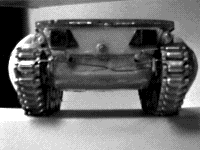 It is only 12 cm long, 8 cm wide, and 45 mm tall. Its weight is only 270
g and it is as fast as its predecessor: 9 cm/s. The "m-" in its name emphasises
this miniaturization. This KYTRON has 251 electronic components, including
9 ICs.
It is only 12 cm long, 8 cm wide, and 45 mm tall. Its weight is only 270
g and it is as fast as its predecessor: 9 cm/s. The "m-" in its name emphasises
this miniaturization. This KYTRON has 251 electronic components, including
9 ICs.
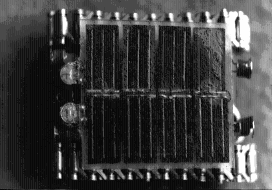
It is the first KYTRON to have solar cells. In bright sunlight these cells deliver enough energy to completely power the logic and the motors. In dimmed light they charge the batteries. In the dark this KYTRON is able to drive up to one hour from battery.
The housing is made of fiberglass again, and is water protected. The solar cells are embedded in the clear polyester screw-top.
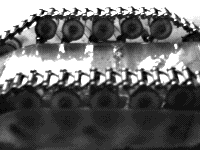 The cast metal tracks of m-KYTRON 3 are running on 14 polyester wheels,
the 10 road wheels have full suspension.
The cast metal tracks of m-KYTRON 3 are running on 14 polyester wheels,
the 10 road wheels have full suspension.
The touch sensors are so sensitive as to react to a single blade of grass. The sensitivity of the silicon eyes of m-KYTRON 3 is gain-controlled over 6 orders of magnitude. This allows for detection of bright ways in sunlight as well as to find a small match flame in the dark. The simplified logic of m-KYTRON 3 was able to avoid simple obstacles:
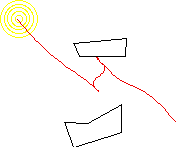
A short movie clip in MPEG is shown here.
Here is a color movie clip (0.28
MB) showing m-KYTRON
3 following the moving spotlight.
Here is a color movie clip (0.34
MB): m-KYTRON
3 follows the torchlight and crashes with the camera.
Return to top
of page...

The initial version of KYTRON 4 from 1977 was very simple and can be left out here.
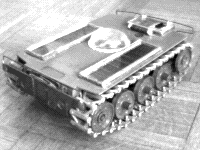 However, in 1980 the logic circuitry was completely replaced by a new design,
using the Motorola "ICU" MC14500B microcontroller. This was a step forward:
The behaviour of the KYTRON (renamed to c-KYTRON 4) is now controlled by
its ICU, a programmable device (one could call it computer), that is, by
software. The program is stored in a low power static RAM chip, which is
always powered.
However, in 1980 the logic circuitry was completely replaced by a new design,
using the Motorola "ICU" MC14500B microcontroller. This was a step forward:
The behaviour of the KYTRON (renamed to c-KYTRON 4) is now controlled by
its ICU, a programmable device (one could call it computer), that is, by
software. The program is stored in a low power static RAM chip, which is
always powered.
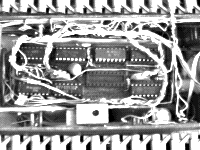
Programming is done either by typing
the program in binary (!) directly into the system, using a simple plug-in
control panel. 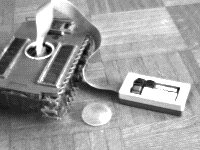
Or one can develop the program on another computer and download it into the KYTRON 4 memory using a kind of direct memory access.
The electronics of c-KYTRON 4 consist
of about 110 electronic components, including 10 ICs and the microcontroller.
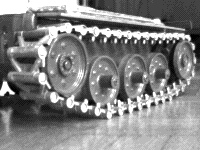
The mechanics are rather simple, but efficient. The body was soldered from
epoxy print material (same as for circuit boards). The wheels and tracks
were taken over from KYTRON 1.
Return to top of page...

In 1978 the youngest member of the
KYTRON family came to life. KYTRON 5 is even more miniaturized than m-KYTRON
3. Its design was the smallest possible, given the accessible components
at that time. (Imagine 1978: SMT did not exist, and the smallest then available
motors/gears were used. The motors/gears together with the rechargable
battery determine the outer shape of this vehicle.)
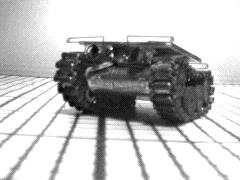
The physical dimensions are: Length
6.5 cm, width 5 cm, height 2.8 cm and weight 115 g. Its speed is 9.7 cm/s,
faster than KYTRON 2 and 3. It can operate up to one hour from battery
in the dark. In bright light, the solar cells recharge the battery. This
KYTRON has 131 discrete electronic components, no IC, all squeezed into
a space of less than 2 cm3.
The logic of this KYTRON, although really primitive, was more consequently designed to search for energy. It has six (gain controlled) eyes, to detect even the slightest chance of a light source. When it successfully reaches the nearest (brightest) point, it stops to let its batteries be recharged. When the light moves away (e.g. a moving sunlight spot in a room) KYTRON 5 follows it immediately.
This is shown in this MPEG movie: KYTRON
5 trying to stay under a moving light source.
Return to top
of page...
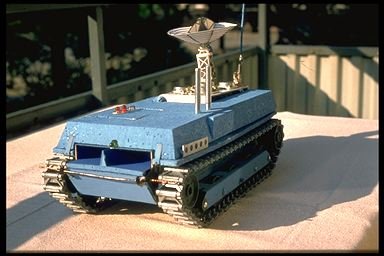 KYTRON 1 on a table
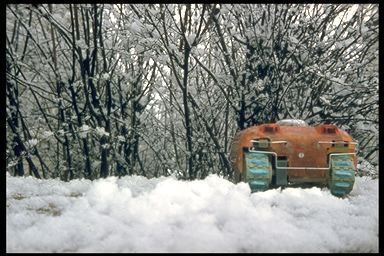 KYTRON 2 driving in
snow
KYTRON 2 driving in
snow
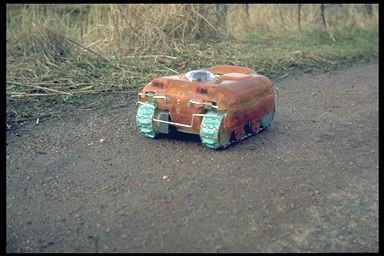 KYTRON 2 on the road
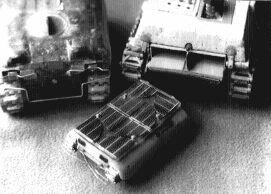
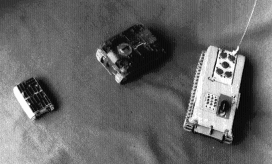 m-KYTRON 3, KYTRON 2 and KYTRON 1
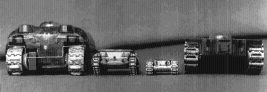 KYTRON 2, m-KYTRON 3, KYTRON 5 and c-KYTRON 4
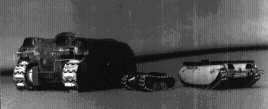 KYTRON 2, KYTRON 5 and m-KYTRON 3
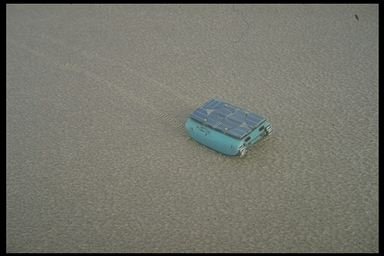 m-KYTRON 3 on the beach
of the French Bretagne
m-KYTRON 3 on the beach
of the French Bretagne
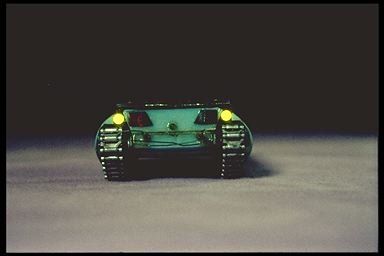 m-KYTRON 3 uses its
timer on a trip in the dark
m-KYTRON 3 uses its
timer on a trip in the dark
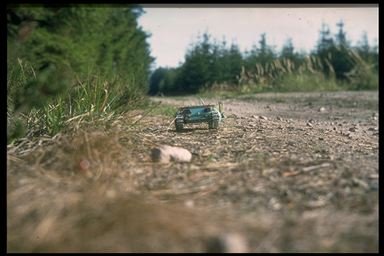 m-KYTRON 3 following
the sun
m-KYTRON 3 following
the sun
The next picture shows the solar cell panel of m-KYTRON 3:
 KYTRON 5 in an early
state (Jan 1978)
KYTRON 5 in an early
state (Jan 1978)
The next picture shows the solar cell panel of KYTRON 5:
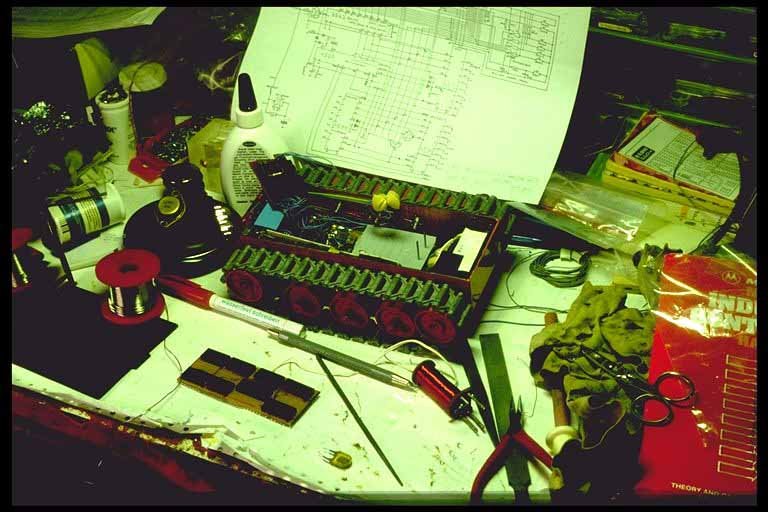 KYTRON 4 gets all-new
electronics including the MC14500B microcontroller
KYTRON 4 gets all-new
electronics including the MC14500B microcontroller
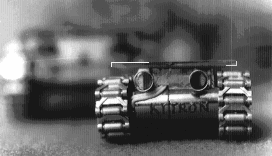
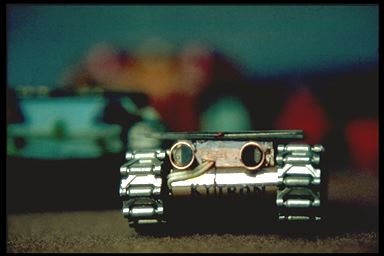
A front view of the tiny KYTRON 5:
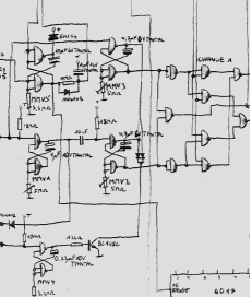
Two small examples of the hand-sketched schematics:
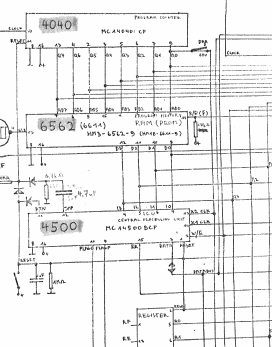 Sketch of the microcontroller of c-KYTRON 4
Return to top of page...
A simpel Java applet simulator can
be found here. This one is a Java applet, so you need a Java-enabled browser
like Cyberdog 2.0, Netscape 3.0, Internet Explorer 3.0 or newer to view
the simulator applet.
page created by
Last major update: Nov 11, 1999
Minor update: Nov 15, 1999
Created by rm using HTML.edit and MacWeb.
Some editing with BBEdit lite w HTML
extensions.
Some editing with HTML Pro 1.08.
All movies created with the original
Connectix QuickCam.
Page originally created in Sept 1993
KYTRON
It's a classic track robot, very similar
to a tank. It's quite old in
its concept but we included it our
essay because of the interesting
close movies of its tracks.